Arturo Hilario
El Observador
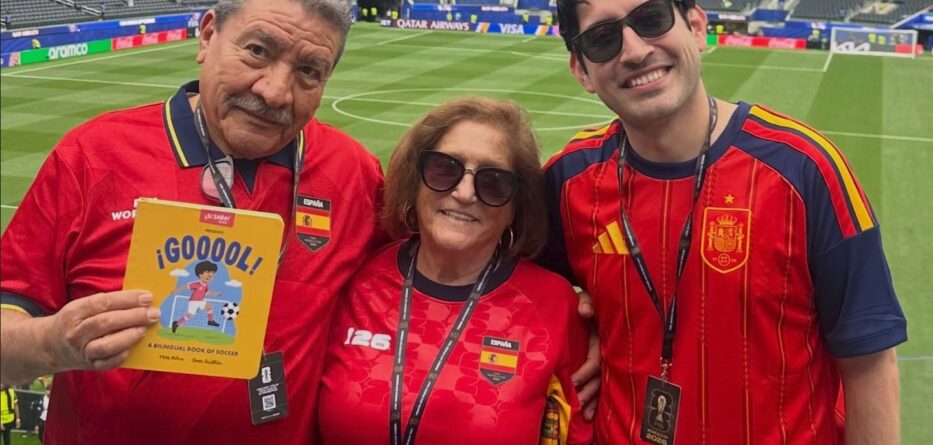
Guatemalan born writer, artist and content creator Mike Alfaro has had a great time with the FIFA World Cup in recent weeks. He took his parents to their first game at SoFi Stadium in Los Angeles and was elated that a dream he shared with them became a reality.
“I can take my parents to this finally. Like those things that we talked about, growing up, now it’s here in my backyard, like 15 minutes away. I got to take advantage of it.”
As the world prepares to see the final on Sunday July 19 between Argentina and Spain, Alfaro hopes that a children’s book he wrote can help bridge the gap between soccer aficionados and new fans, and those that speak English or Spanish.
¡GOOOOL! is one of the most recent of Alfaro’s 13 children’s books he’s written under the “Sí Sabo Kids” series, creating a unique blend of bilingual early language learning activity books that introduce concepts like soccer, Spanish letters like ñ, and learning about local neighborhood staples like the panadería (bakery).
“I think it’s perfect right now for the summer. ¡GOOOOL! is perfect for teaching kids all about the World Cup because of the vocabulary as well. It’s a nice story where you can learn about fútbol, all the different rules, and then you have, you know, vocabulary words like árbitro. And I always tell people, if your kids think that ‘tacos de fútbol’ is something that you eat, not like what you wear on your feet, then you need this book. Like, this is for you.”
Before the 13 books though, Alfaro was most known for his now ubiquitous tabletop card game, Millennial Loteria, an updated version of the most iconic version of the traditional Mexican board game that is similar to bingo and features colorful boards with artwork that was first released in Mexico in 1887.
The popularity of Alfaro’s Millennial version led him to work with major retailers like Target and Walmart and brands which helped him establish himself not only as a content creator who made a board game, but allowed him to expand into books and his passion to create bilingual and cultural resources he himself uses as a father.
Bilingualism & Fatherhood
Alfaro’s journey to becoming an advocate for bilingualism started with his parents and then continued on when he became a parent himself.
“My mom and dad grew up in Guatemala. I grew up in Guatemala until I was 18 years old. So it’s a Spanish-speaking country. My parents only spoke Spanish, but they knew the importance of having another language to open up sort of the doors of the world for me.”
“They gave me books in English and put me in a school that was dual language. And they really pushed that even though they didn’t have that skill of speaking English, they knew they wanted that for me, for their son.”
Alfaro becoming a father was the other big catalyst to the pivot to writing children’s books and helping create resources for others that weren’t readily available.
“I became a father and bilingual education was something that I was really looking forward to. You know, passing down to my daughter.”
While doing an online search for educational tools to share with his daughter, he came across a gap in the market by accident.
“A funny thing is, one of the inspirations just came from like a Google search or like an Amazon search, because when you’re trying to teach kids to speak Spanish, rolling your R’s is one of the harder things that you can do. It’s a very hard thing to teach. And so I was looking to make a sound book, and I was like, ‘It’d be really cool if we had a sound book that was about the letter R, and how you have to roll it.’”
After realizing there wasn’t a book or resource that could easily help kids learn to roll their R’s, his former career in advertising soon took hold and ideas formed.
So I think there’s a responsibility with my books too, that I try to make sure that it’s something that has a positive effect, whether it’s growing up knowing that street vendors are a great part of the community, or knowing that it can be fun to try to roll your R’s or that reggaeton is a part of America now.
-Mike Alfaro
“And like no books, nothing came up. It was like there was no resources in a way that would help this aside from like some, you know, little like written tutorials or something like that. There wasn’t anything that was in the book format that could help kids or like educators. And I was like, ‘That’s a gap in the market.’”
From that came How Do You Roll Your R’s? a book that now easily pops up when searching for that exact type of resource for kids. It includes twelve sound buttons so the learning can come directly from comparing to the book sounds.
“People can push a button and hear how words are said. If you are a parent that doesn’t know how to roll their R’s, you could still use this book to teach your kid how to roll their R’s. I remember my daughter had trouble with it. I was like using the book, trying it on her, and then, you know, she’s at two and a half, she was rolling her R’s perfectly, saying ferrocarril, and I was like, ‘Oh my God, we’re creating stuff that works and helps and there’s a need.’”
So now, by way of his writing, Alfaro wants to pass along the same lessons his parents gave to him to his young daughter, but in reverse.
“Now I’m doing it in Spanish because she’s growing up in an English language country. She’s picking up English from her mom and everywhere, and so I really wanted those resources to teach her Spanish. And I saw that there were a lot of parents out there who actually didn’t know how to speak Spanish that wanted their kids to speak Spanish.”
“Sí Sabo Kids”
In Latino culture there is a term called ‘No Sabo Kid’ which is a derogatory term for Latinos who aren’t completely fluent in Spanish.
A 2023 Pew Research Center survey found that 54% of Hispanics who said they speak no more than a little Spanish have had another Hispanic person make them feel bad for it.
The term brings up a lot of conversations about identity and what it means to be Latino, in recent years there has been a rise of acceptance and bridge-building in Latino communities, instead of shunning those that aren’t proficient in the language they are being embraced and encouraged to keep learning and speaking.
This has opened up the market for options to continue the lifelong efforts to keep bilingualism alive in Latino homes across the country.
“And so a lot of the No Sabo kids, they grew up to become No Sabo adults, and now they want their kids to know Spanish. And so I wanted to make books that really were easy for parents to teach their kids Spanish or to read to them, or if there were parents where one spoke English and one spoke Spanish, I wanted the English parent to have resources to be able to continue that education when the other parent isn’t around.”
Alfaro’s idea to help his own daughter, along with non-speakers, No Sabo types, and everyone in between became a launchpad for his “Sí Sabo Kids” collection, hoping to take daily life and make it fun, educational, and most importantly a cultural bridge.
“It’s been really fun to be able to just kind of put your ideas out there and have them kind of become reality. For a while right now it’s like, ‘strike while the iron is hot,’ and I think there’s a big momentum for what we’re doing and, you know, what we’re creating. And so I just want to keep making things that I see a gap in the market for.’
Highlighting Daily Life & Community
The first collection in the series was called Los Street Vendors and contained three books that highlight Latin American culture through commonly seen street vendors, from El Paletero (ice-cream cart), El Puesto De Flores (florist), and El Carrito de Frutas (fruit cart). All of these were inspired by Alfaro’s daily life in Los Angeles.
“It was inspired by the street vendors that like go down my street. And the corner of my street, like basically every Thursday and Sunday, there’s taco stands and it’s just like a line across the street and it’s just so fun.”
As the collection was published and went out in the world, street vendors and neighbors members began being subjugated to ICE raids and the torment and fear that brought to communities across the country.
“It just so happened that when the book was published was really when a lot of street vendors were getting attacked here by ICE and the community. So it almost felt like I was doing stuff to promote our culture and then something would come to try to attack it and my book would be there to try to like provide some I guess not balance, but like another view of how people would see the value of these hardworking people.”
“And so I realized that I have a platform, you know, that I can create content for Latinos and for things that we love, whether it’s like street vendors or, you know, piñatas or, you know, even like our passion for fútbol. I want to create stuff that reflects that and also helps teach kids Spanish while doing it.”
Reflecting on Millennial Lotería
Years removed from creating the personal art project that became his most popular work, Alfaro reflects on the life he has lived since then, and the work he continues to do.
“That project started as a personal art project. I had quit my job, I worked in advertising, and I just wanted to create a portfolio piece just for me, that was like about how I saw modern Latino people, our culture, like my community, my generation. And so I started making these cards to reflect what we were going through and it just connected so deeply with people.”
Like he has seen various times in his projects, he stumbled on a gap, or need in cultural spaces which flourished once he turned it into a game or a book. “This was like a project that I wanted to see in the world. So I created it and again stumbled upon a need. And that need was representation for, you know, a modern, fun version of like who we are and make it Spanglish.”
“There’s a lot of people out there who like Lotería, who are, you know, who speak Spanglish, who, you know, have family members that speak Spanish, some that only speak English. And this is a way to bridge that gap. So it was really cool to see. But yeah, it’s all been about stumbling on these gaps in the market.”
With the Lotería deck Alfaro sees how fun and communal his work has been, and how he’s seen and heard about the memories and experiences they’ve created.
“You know, when you get invited into someone’s home, that’s like a next level thing. And I think I’ve realized that with my products that I’ve created. With Millennial Lotería, I was invited into people’s living rooms. I was invited into moments where they’re playing with their family. I was invited into like Navidades, Posadas. I was invited into people’s home. And aside from anything else, like the success, there are people who have memories of like maybe staying at an Airbnb and playing this game with their bachelorette party, and that’s a memory that they’ll have, and my game is there. It’s like I’m part of that, and that feels amazing.”
Thirteen books into his children’s author era, he also gets an even more precious and personal opportunity to be in people’s lives.
“With these books, I’m getting invited into like something that’s so important to people, and that is their children, that connection, and being invited. So I think there’s a responsibility with my books too, that I try to make sure that it’s something that has a positive effect, whether it’s growing up knowing that street vendors are a great part of the community, or knowing that it can be fun to try to roll your R’s or that reggaeton is a part of America now.”
“So those are things that there’s a big responsibility with. So I think for me, I just, I’m always happy to be invited into these very personal spaces with our books and hopefully people create memories around them. And, you know, that’s really the best thing that can come out of this feeling-wise for me.”
And as for the World Cup final and watching soccer beyond this summer’s games, Alfaro says you just need to make sure it’s always on the Spanish broadcasts, especially if the goal is to teach or practice Spanish.
“You need to teach them these basics in Spanish and watch the games in Spanish. Watch them on Telemundo. That is a great way to learn a language and to get kids excited about it as well. So that’s what we’re doing here. No English soccer in this household.”
Follow Alfaro’s work on social media @MillennialLoteria @SiSaboKids.