
Graph Credit: Sofia Brazda
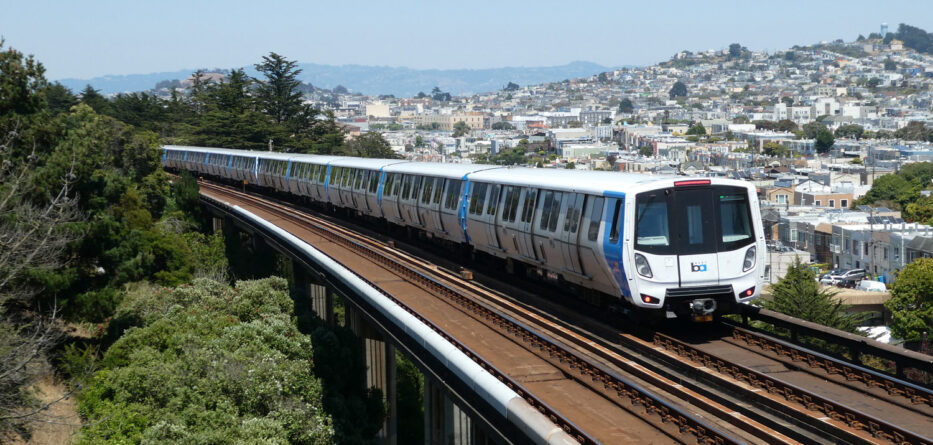
SAN FRANCISCO — When the Bay Area Rapid Transit system launched in 1972 it was the crown jewel of modern mass transit. But with the Covid 19 pandemic came plummeting ridership and an ongoing fight for the agency’s survival.
While BART’s future remains uncertain, a confluence of factors is spurring hopes that it may now finally be turning the corner.
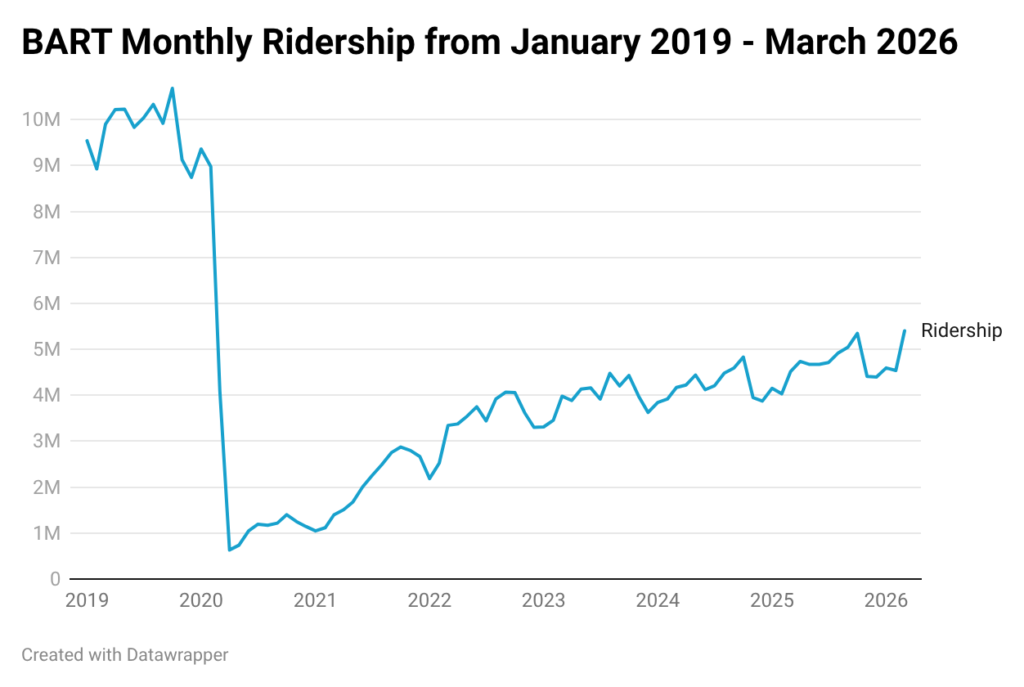
April ridership to date is about 10% higher than last year, continuing positive growth exemplified in March’s record ridership numbers. Part of the increase is due to rising fuel costs from the war in Iran, driving more people out of their cars and onto public transit.
High profile sporting events in San Francisco have also drawn visitors from across the Bay Area into the city. Ridership, meanwhile, surged this past weekend as major renovations shut down a critical eastbound stretch of the I-80 freeway connecting San Francisco to cities across the Bay. BART reported a 16% increase in trips on Friday compared to the week before. On Saturday and Sunday, the amount of trips was up as much as 46%.
The increase comes as gas prices hover around $5.84 for a gallon of regular in California. That’s among the highest in the country and up from around $4.40 in February and early March, before the start of fighting in the Middle East.
Officials say the uptick is an example of the train system’s role as ‘essential infrastructure’ for the region.
“When major roadways like I-80 are unavailable, BART provides a high-capacity, reliable alternative that can quickly absorb increased demand,” the agency said in a statement. “The system’s ability to accommodate tens of thousands of additional riders in a single weekend demonstrates its importance to the region’s mobility and resilience.”
‘A hard sell’
Despite the upward trend, BART ridership numbers are still well below pre-pandemic levels. The agency announced in February that if it cannot close a $376 million deficit, it will axe up to 15 of its 50 stations, reduce hours and services, and raise fares by 30%.
Those steps are part of the Alternative Service Plan approved by BART officials in February. Others have dubbed it the ”doomsday plan,” describing the phased reductions as an existential threat to the agency’s long-term viability.
“It is definitely sometimes a hard sell,” says Kat Siegal, field lead for the Connect Bay Area Act signature gathering campaign. The measure would introduce a half-percent sales tax (one percent in San Francisco) over the next 14 years to help BART regain its financial footing.
Authored by State Senators Scott Wiener of San Francisco and Jesse Arreguin of Oakland, the proposal needs 186,000 signatures to get on the November ballot. In addition to BART, revenue from the sales tax will go to Muni, Caltrain, AC Transit, and other smaller regional agencies.
Most of the roughly 800 signature gatherers across the five affected counties are volunteers. Additionally, the effort is enjoying broad political support from regional mayors, supervisors, labor unions, and nonprofits. The measure is facing no formal opposition — aside from assuring Bay Area residents that another tax is in their interest.
Siegal says while there is general support for BART, people on both sides of the petition effort have concerns. One of those is the Bay Area’s already high cost of living. A half percent sales tax means that for every $100 spent, an additional $0.50 will be added as tax.
“A lot of folks are surprised that we even have to have this conversation, like, shouldn’t there be enough money for public transit?” she says. “That’s a tax on the working class for public transit. So we do find ourselves in a difficult position.”
‘I’d happily pay’
According to BART’s own data, 75% of riders are people of color, with 51% earning less than $50,000 and 53% lacking vehicle access, making the system an essential asset for the Bay Area’s working class residents.
San Francisco resident and daily BART rider Alex Serna says the train is an integral part of his life. He’s concerned about what effect service cuts would have on the already crowded trains at rush hour.
“Between 3 and 6 the trains are packed, really uncomfortable. To cut down even more is just going to be that many more people crammed on the trains.”
As an East San Jose native and Sharks season ticket holder, Serna takes BART down to the South Bay as much as 3 times a week during the hockey season.
“BART is the only thing that makes that feasible,” he says. “Now we’re hearing about all these changes they’re proposing… I’d happily pay whatever the increase is, if that means service stays the same or improves.”
Serna notes that BART conditions have improved over the last two years, especially with cleanliness and bathroom access. He and his girlfriend have both signed the petition for the ballot measure.
“That’s where that money goes also – the quality of the service,” he says. “Even if I didn’t ride BART, if I know that someone’s getting to work on time or has a reliable mode of transportation for the negligible pennies on the dollar I’m paying, I’m not going to notice at all.”
State vs local funding
Transit in California is about 50% locally funded. Additionally, California splits those funds across many independent agencies, rather than one central transit operator.
Connect Bay Area spokesperson Jeff Cretan says the sales tax would go toward filling in that gap between state and local funding. He adds the measure has guard rails in place to make sure the funds are used effectively.
“The sales tax is expected to raise about a billion dollars a year for 14 years. The agencies have expenditure plans, and they also have to meet accountability metrics. They have to undergo efficiency reviews. There’s a citizen oversight committee and there’s different controls in place to make sure that the money is used efficiently and that it can only be used for operations. It can’t be used for capital improvements for those four agencies.”
But Siegal says that ultimately more help is needed from Sacramento to find a sustainable long-term solution.
“I think a lot of transit advocates are hoping that over that time, we can find a way to actually subsidize our local transit at the state level, with the taxes that we already pay. We spend a lot on roads in California. We don’t spend much on public transit operations.”
She added, “I don’t know what the landscape will look like in 14 years. It is possible this is something we’ll have to renew.”
As for the public’s response, Siegal says a lot of people she talks to are supportive of the measure. “Not everybody, but most people do understand, especially if they’re transit riders and they rely on the service.”
A new funding model
BART Director Barnali Ghosh, who represents parts of Berkeley, Richmond, and El Cerrito, points out a major cause of BART’s deficit is its over-reliance on the fare box to fund itself. Pre-pandemic, the agency was making 71% of its revenue from riders – more than almost any other transit agency in the world.
“Before the pandemic, BART depended on fares to pay for about two thirds of our service. Right now fares pay only about a third of our services. So if we were to make up everything from fares, our ridership would have to double,” says Ghosh.
Based on Clipper card data, 76% of pre-pandemic riders are back, they’re just riding less frequently. Ghosh says the eventual solution will have to be in diversifying BART’s revenue sources.
“If the measure passes, the very next day I think as transit agencies we’re going to have to come together to figure out what happens when the sales tax ends,” says Ghosh, “It’s our opportunity to figure out other financing models.”
Chris Alam is a California Local News Fellow with the UC Berkeley Graduate School of Journalism.
Photo Caption:
Spanish Photo Caption: Interior de un coche D nuevo del BART en marzo de 2018. Photo Credit: Wikimedia Commons