
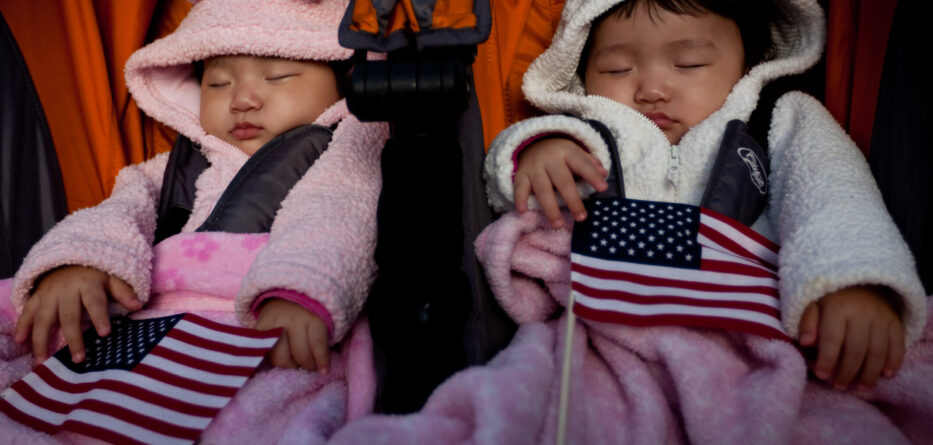
The April 1, 2026 Supreme Court case on birthright citizenship is, on its face, about the “inalienable” right of US-born children to be U.S. citizens under the 14th Amendment, a right enshrined in the Constitution with roots extending back to early 17th Century English common law.
At its core, the case, Trump v. Barbara, is a fight for the soul of democracy.
Trump’s assault on birthright citizenship, beginning with his 2025 executive order, “Protecting the Meaning and Value of American Citizenship” — around which the April 1 case hinges — is in essence a grandstanding assault on immigrants aimed at cementing authoritarian control of the federal government.
Look to Minneapolis
Under Operation Metro Surge, the administration sent more than 3000 federal immigration agents to the city, dwarfing Minneapolis’ own police force by degrees and wreaking havoc on communities.
If authorized by Supreme Court justices, constraining birthright citizenship will have much the same effect, with fallout for an already vulnerable U.S. economy — made more so by Trump’s reckless misadventure in Iran — and civic life. Such a ruling would also empower the federal government to commandeer hospitals, schools and other public institutions as unwilling vigilantes in enforcing administration policy.
Indeed, the case cannot be viewed outside the wider context of Trump’s war on immigrants with its aggressive ICE enforcement, record mass detention, and calculated efforts to leverage cruelty as a tool to promote self-deportation of as many immigrants as possible and, with them, their US-born children.
The administration’s effort to wipe out birthright citizenship is also linked with attempts to erode the safety and security of our immigrant neighbors, including current attempts to overturn the 1982 court decision Plyer v. Doe, which affirmed the right of all children, regardless of their status, to a free public education.
The 14th Amendment
A hurricane of legal controversy has emerged in the current case about three intertwined issues in the language of the 14th Amendment:
- Allegiance to the US (although this consideration cannot reasonably apply to newborns but does explicitly apply to naturalized citizens who must swear allegiance to the US)
- Children born in the US being “subject to the jurisdiction thereof” as a condition of birthright citizenship
- Whether immigrant parents of children born in the US are temporary or permanent residents
What about the allegiance argument?
The administration’s argument that newly-born children should be denied citizenship because of their parents’ legal status features prominently in their brief. As Solicitor General John Sauer argues, “the children of noncitizens “who are domiciled elsewhere, and are only temporarily present in the United States, owe primary allegiance to their parents’ home countries, not the United States.”
This is an arbitrary legal fiction. The American Academy of Arts and Sciences, summarizing an extensive body of research, shows that 2nd generation immigrants (the US born children of immigrants) are highly civically engaged, in part in response to social injustice experienced by their parents.
What about the jurisdiction argument?
Despite frequent admonitions for judges to read statutes and case law precedents focusing on “plain language” there is a great deal of argument about whether unauthorized immigrants are subject to the jurisdiction of the US.
As data on detentions and deportations of some half million immigrants this past year makes clear, all non-citizens — whatever their legal status — are subject to both federal, state, and local jurisdiction. IRS statutes and regulations, and the number of ITIN filers who are not eligible for SSNs make it equally clear.
What about the residence (temporary or permanent) argument?
This argument stems from 14th Amendment language saying that US-born children are citizens of the state where they live and the United States. The arguments about what this means, often framed as being about “domicile,” are technical ones, tied to complexities in immigration law, making for a range of potential consequences from an adverse Supreme Court decision supporting the executive order.
A chilling memo prepared by USCIS in July, 2025 proposes tremendously problematic determinations about implementing these provisions. Children born in the US who are denied citizenship would include those with parents deemed “temporary” due to living lawfully in the US as TPS beneficiaries, for example, or having a “dual intent” visa (e.g. H-1B), deferred action recipients (e.g. DACA), U visa holders (victims of crime), T visa holders (trafficking victims), and many others.
The USCIS memo holds out the olive branch to these US-born children that they would not suffer adverse immigration consequences such as deportation. It makes no mention of what might become of their parents.
Social, economic fallout
Migration Policy Institute analysts estimate that about 222,000 children born in the US would be denied citizenship each year if the executive order — which would apply to children born after Jan. 1, 2025 — is approved.
That amounts to a loss of an estimated $927 billion to the U.S. economy during these children’s working lives, according to the Center for Migration Studies of New York, a leading immigration research center.
The legal arguments in briefs filed by the administration, by ACLU in its defense of birthright citizenship, and in amicus briefs on both sides of the issue are practically very important. At the same time, they provide only a blurry mirror for understanding the real-world political and societal issues brought to the surface in this historical battle.
The stakes in this case are extraordinarily high, not just for immigrants but for all Americans. Failure to support the principle and practice of birthright citizenship will lead to yet more civic and economic chaos and will push this country further down the path of authoritarian control.