Roxsy Lin
American Community Media
Often described as Mexico’s cultural capital, the state of Oaxaca is renowned for its deep Indigenous roots. But those roots don’t end in Oaxaca. More than 2,000 miles to the north, Los Angeles, California has emerged as a center of Oaxacan identity and culture.
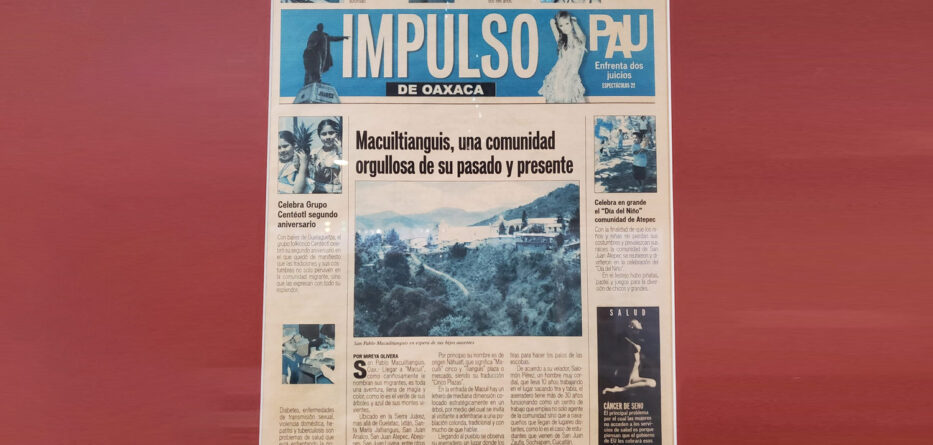
Mireya Olivera, founder of the Spanish-language newspaper Impulso, has for more than two decades devoted herself to honoring that heritage.
“I didn’t have a single dollar to start the project,” recalls Olivera of those early days in 2004 when the idea for Impulso first began to take shape.
Olivera studied journalism at the Instituto de Estudios Superiores in Oaxaca, graduating in 1992 before moving to Los Angeles. Prior to starting Impulso, she had been working for El Oaxaqueño, a small newspaper that eventually went out of print.
Indigenous communities ‘invisible’
A friend and local community advocate, Guadalupe Rosas Bojorquez encouraged her to take the leap. Another friend and restauranter, Teresita Hernández loaned Olivera $2,000 to get the newspaper off the ground. The funds allowed her to buy a computer, a printer, and a camera, as well as to travel to Oaxaca to hire a designer and establish the contacts necessary to launch.
Impulso’s early stories highlighted community celebrations across the city, from Mother’s Day to Día del Niño, or Children’s Day. Coverage expanded to new folkloric groups and local basketball games, all popular within the community. A calendar of events soon followed, helping readers stay informed about upcoming celebrations and gatherings.
All of this was a far cry from the near absence of the Oaxacan community in both mainstream English and Spanish language media of the time. Olivera says she often heard from community members, especially those from smaller Indigenous groups, who said they felt invisible.
There are 16 formally recognized and distinct Indigenous groups in Oaxaca, which sits along Mexico’s southwestern tip. These include groups like Zapotec and Mixtec, both of which have seen their presence grow in Los Angeles in recent decades.
LA’s Oaxacan Corridor
Estimates put the Oaxacan population in Los Angeles at more than 180,000, the largest Oaxacan community outside of Oaxaca. In 2024, the city officially designated a stretch of Pico Boulevard as the “Oaxacan Corridor” to honor Oaxacans’ contributions. The designation followed the leak two years earlier of audio recordings in which Latino elected officials were heard disparaging Indigenous Oaxacan residents.
“Within the Mexican community here, people would refer to Oaxacans as ‘Oaxaquitas,’ or ‘little Oaxacans,’” says Olivera, a pejorative with racial undertones meant to belittle Indigenous peoples and their cultures. “We worked to change that.”
Immigration raids
More recently Olivera’s team has focused on the immigration raids that have targeted Los Angeles and cities across the country. According to Olivera, the city’s Oaxacan community has been among the hardest hit by the raids.
“Reports from the Mexican Consulate General in Los Angeles suggest people from Oaxaca are among the three Mexican communities most impacted by the raids,” she said. “At the beginning of the immigration operations, they were second only to people from Michoacán in terms of detentions.”
Olivera cited cases of individual arrests including 14 family members from the Zapotec community during a raid on the city’s garment district and the high-profile case of Arturo Vásquez, a baker who had been living in Los Angeles for 27 years at the time and had no criminal record.
“Impulso has kept the community informed about the raids that separate working families and create chaos in their lives,” she said.
Present in the community
Luis Carmen is from the Zapotec community and has been following Impulso since it first launched. He says the paper has helped Indigenous communities like his own become more aware of one another.
“Impulso has taken the initiative to be present at events, to help publicize them, and to support communities in promoting their festivities,” he said. “Without that, I don’t think we would know one another as well as we do today.”
Carmen says he treasures the small daily ritual of sitting in his backyard to read the latest issue, which he finds at El Chapulín restaurant, or at the Valle Oaxaqueño bakery. The paper is distributed free of charge every two weeks at locations across Los Angeles and Santa Monica.
‘A source of pride’
In 2010, Olivera was diagnosed with a breast tumor, a moment she describes as one of the most challenging periods of her life. During her surgery and postoperative recovery, support from the community, along with family and friends, proved essential to her healing.
Her husband assumed full responsibility for the newspaper, meeting with clients, securing advertising, overseeing printing, and managing distribution. At the same time, colleagues, including Nora Estrada, now a copy editor and reporter at Impulso News, and Myriam Reyes, kept the publication running from Olivera’s home. Community members brought food, gifts and words of encouragement.
“When we arrive from Oaxaca, we bring with us all those cultural values we have … of unity and collective work, all for the common good,” noted Olivera, whose friendly demeanor and contagious laugh clearly resonate with people in her community.
In the 21 years since its first issue, the paper continues to reflect the community it serves.
“It is a source of pride that there is a Oaxacan newspaper here that informs us about what is happening both here and in parts of Oaxaca,” said local businessman Arturo Aguilar, whose company advertises with the paper. “It is also part of teaching our children about what Oaxaca is and its traditions.”