
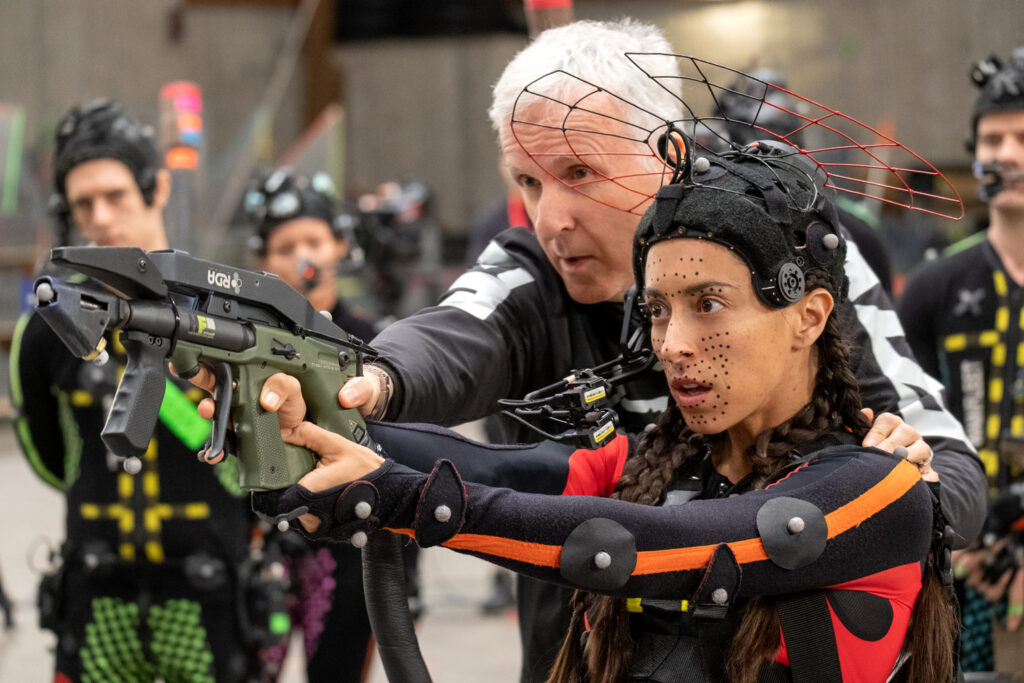
Director James Cameron and Oona Chaplin on the set of 20th Century Studios’ Avatar: Fire and Ash. Photo Credit: Mark Fellman. © 2025 20th Century Studios. All Rights Reserved.
Arturo Hilario
El Observador
It’s time to return with the Na’vi people, now with more fire and chaos thanks to Charlie Chaplin’s granddaughter.
Actress Oona Chaplin, known for her roles in Game of Thrones and FX’s Taboo, has joined the world of Pandora as the lead antagonist of the newest journey into the vast and lush landscapes of the James Cameron epics that have redefined what filmmakers can do with the bridging of cutting edge technology and sincere human performances.
Although Chaplin was born in Madrid, Spain to English-American actress Geraldine Chaplin (daughter of Charlie Chaplin) and Chilean filmmaker Patricio Castilla, she has roots all around the world, living in Cuba, Switzerland and the United Kingdom. And now a part of her lives in Pandora too.
With Avatar: Fire and Ash, the Sully family must deal with a huge loss from the previous film Avatar: The Way of Water while a new threat emerges alongside unexpected allies. A fight for resources, spirituality and control will erupt between the Na’vi, the Ash People, and Colonel Quaritch (Stephen Lang) and the human RDA (Resources Development Administration), testing the foundation of the Sully family and all of their allies.
Returning protagonists Sam Worthington (as Jake Sully), and Zoe Saldaña (as Na’vi warrior Neytiri), are joined by Chaplin as the main antagonist Varang, bringing to the film an incredible performance as the leader of the Mangkwan Clan (a.k.a. the Ash People) a community who has built their own beliefs and brutal traditions after turning their backs to the god Eywa after feeling she had abandoned them after a natural disaster destroyed their home.
Chaplin recently spoke with me about her experience with stepping into the digital set of Avatar: Fire and Ash and the legacy of her grandfather Charlie, how his path parallels James Cameron’s, how she molded Varang’s walk and mindset on heartbreak and fire, and why technology is worthless without the human spirit.
Varang is such a captivating character. And although she is seen as a villain and a threat to the Sullys in the film, she exhibits an emotional core that has traits that you see in our own human condition, such as the idea of spiritual abandonment and being dependent on by her community. What was it like juggling these two sides of her, being a survivor and a leader, while also a villain and a threat to others?
Thank you for that. I’m glad that that is coming through because that was really important to me. I never saw her as a villain. I never wanted to play her as a villain. For me, it was of utmost importance to have her pain and her trauma really present at all times. And that was really the key to her because she’s a great leader in a lot of ways. She has a lot of integrity and this incredibly strong code of ethics that exists, that she really lives by. But her pain is her greatest weakness, but also, she’s managed to harness the power of her pain and her trauma and turn it into her greatest strength.
And that is the piece that really interested me about her and that I really wanted to come through, is that everything that makes her afraid, her first instinct, this is something James Cameron told me, his first instinct is to go towards it. And then you decide what you’re going to do with it, whether you destroy it, you eat it, you devour it, you have sex with it, it doesn’t matter. But the first instinct when there’s something powerful, she goes right to it because the last time, something that was powerful destroyed everything.
And so she’s a very curious person, and I’m really grateful to the incredible work of Jim Cameron and all his geek squad that somehow managed to preserve that complexity through all of the computer work that is magic to me.
But at the core, this is a human story. I think technology is absolutely worthless until we put some heart into it. The thing that has the most value to me is the human heart and the spirit…It’s like that magical thing.
-Oona Chaplin
It does looks like magic on the screen. So on the technical aspect of it, how did you get those physical mannerisms of Varang and her walk, her effortless poses. What was the process of building that character there in the physical space where she’s regal and menacing at the same time?
For me, there was two really important keys. Three, actually. The first one is going to Hawaii and seeing the lava fields and seeing how the lava moves. Lava is so powerful, and it’s like this tongue that’s coming out of the Earth, but it’s unstoppable. And so really understanding that that is her teacher. The fire of the mountain is her teacher. And so that’s what she’s been studying for the past however many years. So that was the one key.
Then the next key was the Buugeng, which is her weapons, the S-like weapons. Working with those, I obsessively practiced with those. I brushed my teeth with a Buugeng in my hand because they require so much precision, but they also require flow. And that was something that helped me understand how she is. She’s precise, surgically, but she’s also in the flow in that way. And then the big piece was really studying Zoe Saldaña and to see how she was moving as Neytiri. And then realizing and hearing her speak about it, she moves from her heart because the Na’vi do not lie, and so they trust. And so, they move, they initiate their movement from their heart.
But when you’ve lost that trust and your heart is broken, I suddenly realized I was like, we have to close her heart and tighten around the chest. And then where does she move from? And then it just happened. The movement was born from the pelvis. And then that kinda turned her into a femme fatale. It’s pretty cool to see.
How do you feel about being part of this project and seeing James create this touchstone film and filmmaking technology for our age with Avatar while also you yourself having the legacy of your grandfather, Charlie Chaplin, doing groundbreaking technological leaps in his era of filmmaking? Both James and Charlie created human stories with heart at the core, so how do you feel about that?
You hit the nail right on the head. Charlie Chaplin was an innovator and at the time, I imagine that people that were theater goers, I imagine how appalled they would be at the idea of cinema. I imagine how much they would scoff at it and say, “Oh, these actors get to repeat it, and you’re not even there in the room with the audience. It’s all cheating,” like what people think about the CGI that we use in Avatar, and somehow that was lesser acting.
But then [Charlie] made the whole world laugh and cry together in a way that a theater performer could never do because there’s just not enough time. And so he also, through laughter and the tears, he united the world at a time of a lot of conflict and great confusion and despair, war and horrible things that were happening at the time. And so I think about that and think about James Cameron, who’s now doing all of this stuff with the 3D and the CGI and the digital makeup and performance capture and all that. And yeah, he’s telling the stories that are asking really important questions about where we are as a species and also who we are as people, as individuals within our families, within our communities, within the greater arc of time.
“And what is your mission? What are your values? When is it right to take up arms and join the battle? When is it right to be peaceful and walk away? How do you deal with grief?” Really core questions. And he’s united us in turning us all blue. Across political lines, across religious beliefs, across national borders, everybody that walks into the Avatar film in the cinema, we’re all Na’vi by the end of it. We’ve all gone blue. It’s amazing. At a time of, again, great conflict and confusion and division and freaking existential crises. It’s like, this is a really cool film.
Can you touch on the diversity and representation of the casting and how that reflects a movie that tells the story that’s universal, that reaches out to anybody in this world that’s willing to sit down and watch it?
I mean, it feels to me that this kind of performance capture in the Avatar world and fantasy in general can offer us a break from the prejudice and the prisons that we have in our minds around who can play what. I mean, Sigourney Weaver is a teenager. How incredible is that?
And I feel like more and more we see stories that are not only a reflection of our society, but also just It’s a reflection of our humanity. So I’m really keen for films like Avatar and just films in general to just focus more on who we are as people instead of things that have disqualified people from being able to play certain roles.
After working on Avatar: Fire and Ash, has the whole process changed or reinforced your feelings on the craft of filmmaking? Does this experience show you that it’s all similar despite the technology being used, or does it give you a new viewpoint of the process of making films?
I think one of the key things is something that you’ve touched on is that James Cameron is technologically just breaking all of our minds. I mean, it’s just incredible what he’s managed and him and his team and his artist that he works with are able to create. But at the core, this is a human story. I think technology is absolutely worthless until we put some heart into it. The thing that has the most value to me is the human heart and the spirit. It’s the spirit, even, not even the heart. It’s like that magical thing.
We’re conscious, we’re aware, we’re driven by these impulses that are so mysterious, and how we love, how we hate. These are things that are so bewildering and fascinating to me. And those are the stories that I like. I think those stories can be told in a black box theater, and they can be told in this incredible CGI that we have. And sadly, I don’t see a lot of those stories being told. I see a lot of really clever stories being told out there, things that boggle the minds, that are cool, that make you think.
But I like stories that make you feel. And that’s for me, the past, the future, and the present of cinema. That’s the cinema and the storytelling of theater. The music that I like is the ones that help you connect with your heart and somehow also, I don’t know, make you want to be a better person when you come out of the cinema.
Avatar: Fire and Ash is now exclusively in theaters.