
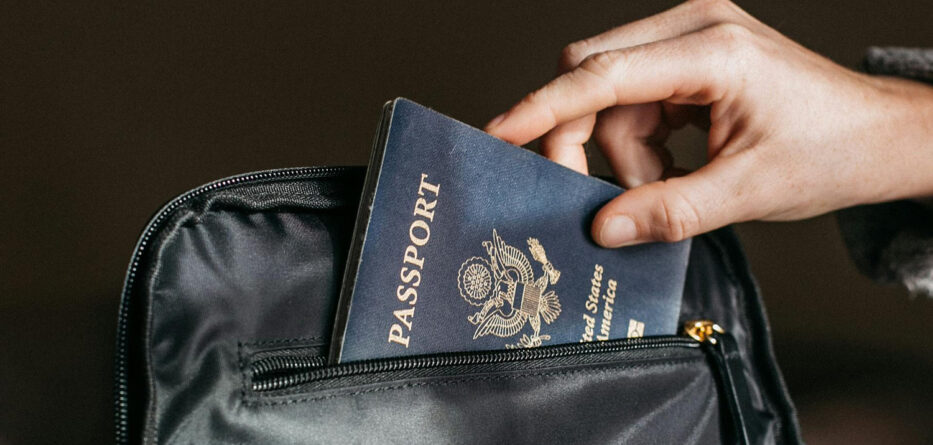
For most Americans, the passport has long been a document of convenience: a small blue booklet associated with travel abroad.
It sits tucked away in a drawer, used for vacations or business trips, and then disappears again. But an ongoing political and legal shift could be redefining what that document signifies—not overseas, but right here within the country itself.
The Save America Act—which has passed the House of Representatives and enjoys broad popular support—seeks to require proof of identity to register to vote, along with a photo ID on Election Day.
If passed by the Senate this week, it would mark a transformation in how civic participation is verified in the United States.
And within that conversation, the passport is emerging as one of the most powerful tools a citizen can possess.
It is estimated that around 47% of U.S. citizens do not hold a passport—equivalent to 148 million people.
Unlike driver’s licenses or state-issued IDs, the U.S. passport serves as proof of both identity and citizenship in a single document.
Many forms of identification compliant with the REAL ID Act can confirm who you are, but they cannot definitively prove that you are a citizen entitled to vote.
If new requirements place equal emphasis on both identity and citizenship, the passport becomes essential: it is widely accepted, difficult to challenge, and issued at the federal level.
The reasons why millions of Americans do not have a passport vary. Some have simply never needed one. Others are deterred by the cost, the paperwork, or the time required to obtain it. For many low-income individuals, seniors, or residents of rural areas, obtaining a passport can be far less straightforward than it might seem.
When participation in democracy becomes tied to access to specific documents, the disparities regarding who possesses those documents begin to matter.
It is not that the passport itself is exclusionary; rather, the path to obtaining one is not equally easy for everyone. Proponents of stricter voter ID laws argue that they are necessary to safeguard the integrity of elections. From this perspective, requiring verifiable identification—especially something as robust as a passport—is simply common sense.
Critics, however, see a different pattern. They point to historical precedents in which administrative hurdles—however neutral they may have appeared on the surface—ultimately served to limit the participation of certain groups.
This tension—between security and access—has no simple solution.
As Election Day on November 3rd draws near, the practical implications of these policies are becoming increasingly clear.
For some voters, nothing will change. For others, the process could become more complex, requiring additional steps, documentation, and planning.
In this context, a passport begins to look less like a travel accessory and more like a guarantee: a document that ensures you can participate fully in the democratic process. And that alone makes it well worth obtaining as soon as possible. To start the application process, visit: https://www.usa.gov/es/solicitar-pasaporte-estadounidense-primera-vez.