Arturo Hilario
El Observador
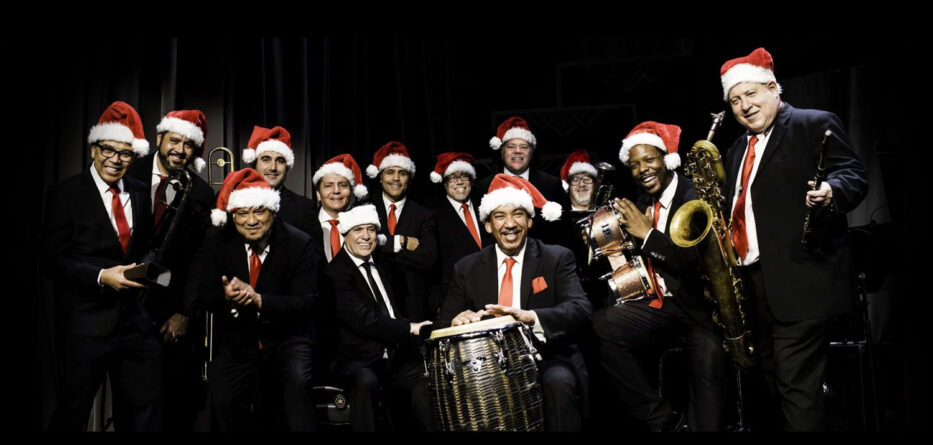
Latin jazz ensemble Spanish Harlem Orchestra is celebrating their 25th anniversary with a Christmas themed album called Salsa Navidad that encompasses their history, New York City and the complexities of Latino culture, all in one 52-minute showcase of what has kept the three-time GRAMMY Award-winning group relevant since its inception at the turn of the century.
Coming to the Miner Auditorium as part of Holidays at SFJAZZ for two days, Saturday December 13 at 7:30pm and Sunday December 14 at 2pm, the Salsa dance party will have tickets for a standing room area in front of the orchestra for dancing to the Latin holiday tunes as well as traditional seats.
Spanish Harlem Orchestra, or SHO for short, is an ensemble of Latin jazz musicians from New York City that have brought the sounds of the Big Apple and of Latino culture to every corner of the world, with it showing the technical prowess of their accomplished musicians and their vivacious Latin roots, a blend of American jazz and the Latin music that permeates Spanish Harlem and the Bronx, honoring music history and Latino culture with every sizzling note.
Although they have a total of ten albums, this is their first Christmas record and according to founder, bandleader and acclaimed jazz pianist Oscar Hernández, it will probably be their only one.
“This is the first Christmas album, and probably the only one we’re ever going to do. But I’m really happy. I think we got it right. I think that everything came out as good as it could be expected. The reaction has been phenomenal, so I’m really happy.”
Hernández recently spoke to El Observador about the SHO’s first Christmas album, why he hopes it will become a tradition to listen to alongside Mariah Carey and Bing Crosby during the holiday season, his own history and passion for music and education, and why it’s more important than ever to showcase Latino culture in this politically tense climate.
For more information on Spanish Harlem Orchestra and their San Francisco shows, visit sfjazz.org/tickets/productions/25-26/spanish-harlem-orchestra/.
Can you tell me a little about how that concept for a holiday record came to be and what that experience was like?
About five or six or seven years ago, they asked us to do a holiday show. And so I put together some music. And since then, they’ve been asking us to do holiday shows. Matter of fact, last year, we did 12 dates on the West Coast with this holiday show. [But] I’ll never do a complete holiday show. Half the show is us, and the other half is dedicated to holiday music.
So, based on the success of that, people would always ask me, “When are you going to do a record, man? This music is great. When are you going to do a record?” And I hadn’t really given it much thought. But after thinking about it and after being prompted so much, I said, “The Hell with it, let’s do a Christmas record.” It’s a good thing because if you get it right, it’s a Christmas record that could sell for years long after I’m gone. There are a few records like that. As you know, we hear those same songs every Christmas, right? Whether it be Mariah Carey or Bing Crosby or Frank Sinatra or Tony Bennett.
The people who have done great Christmas records, we hear all those songs during Christmas every year. So hopefully that’ll be the case here because I think we put out a great record.
Spanish Harlem Orchestra, I’m proud to say, is going on celebrating 25 years. We’ve always done great records. I’m really proud of what we’ve accomplished in our 25 years. This is our 10th recording, and we’ve gotten six Grammys nominations, and we’ve won three Grammys. So it doesn’t get much better than that. Really happy and really proud of what we have accomplished in those 25 years. And now this is a feather in our cap in a different way with a Christmas recording. We’ve gotten great feedback so far.
You get accustomed to all these classic Christmas songs, and sometimes you need a little something different. And there aren’t too many Latin jazz Christmas albums that pop up on Google search.
Look, just to give you an example. So a million people have recorded “Jingle Bells”, but not like the way we did it. So the truth of the matter is if you find a more swinging version of “Jingle Bells” than the one we did, you call me and let me know.
I don’t want to sound arrogant. I’m not an arrogant person, but I’ve been doing this a long time, and I really feel good about how we do it, what we do and how we do it, and our commitment and passion to the music. I’m totally committed. I’m totally passionate about a music that’s given me a lifetime of work and a lifetime of traveling all over the world with some important people and playing with a lot of great musicians.
So it comes from a real deep sense of gratitude. And it’s given me an opportunity to do so many things. And I’m from the South Bronx, so I’m from the hood. And I grew up poor, family of 11. And music has been a blessing in my life. So here I am 50 years later, out there kicking major butt. It makes me really proud.
Going back to your start, I was reading that you were influenced by artists like Tito Puente and Willy Colón. What were the inspirations in your world that inspired you to get into music, and specifically to go into jazz?
Well, let me put it this way. In my neighborhood, you heard, almost from every other door, every other window, you heard Latin music. And it was the music of Tito Puente, Machito, Tito Rodriguez, the great trios of those times, the great boleros, singers, ballad singers. And you heard the Salsa of the day, there were so many people. And I’m close to the youngest in my family. So at 10, 11, I would see my older brothers and sisters getting ready to party on the weekends, and they’d be listening to the music.
And also, the way I grew up in the South Bronx, and in New York City, the cultural revolution of Latinos was happening, was occurring dating back from the ’50s and ’60s, but certainly in the ’70s when I got involved in music. So, somebody gave me a piano at 14, and it was straight ahead from there. I started playing professionally at 16 and got involved with neighborhood bands. And Salsa was the music of the day, no doubt. So whether you heard the music of Puente, Celia Cruz, Ray Barreto, Machito, all those people who I got to play with, I played with all of them.
I played with Machito, I played with Puente, I played with Celia, I played with Ray Barreto. All those people who are no longer here, I honor their history and their legacy by what I do with Spanish Harlem Orchestra. And it just so happens I’m not a fly-by-night who took on the name Spanish Harlem Orchestra. If you might not be aware being from the West Coast, Spanish Harlem was one of the key places in New York where the cultural revolution of Latinos was happening. It’s called El Barrio, Spanish Harlem is El Barrio, New York. And music was the thing of the day; social gatherings was the thing of the day, the food, the culture, the language.
That was very much what was important in that neighborhood and other neighborhoods, too, in the South Bronx, where I grew up. Spanish Harlem was 20 minutes from where I lived, so we used to go there to shop and to eat and to do some social events. So it wasn’t a fly-by-night who took on the name Spanish Harlem for the name of the orchestra, it has a meaning and a significance beyond the actual music.
That’s very important that I don’t take lightly. I’m fierce about representing the best of my culture in what I do, which is music. I’ve been blessed to do it now all these years and to honor that legacy and that history from which I’ve been blessed to be a part of.
Spanish Harlem Orchestra turned 25 this year. What has been most rewarding about this journey, about being part of this and starting this orchestra?
Well, on the surface, first of all, let me say three Grammys won, three American Grammys, and six Grammy nominations, that’s on the surface. But beyond that, the real significance is the impact that we’ve had on people. When we perform live, people go like, “Oh, my God, this is some of the best music.” It’s so gratifying when people come up to us and say, “Man, I’ve never heard of you guys. You guys are amazing. This music is amazing.”
And that’s the reaction I get. And we’ve never had a bad concert, whether it’s well-attended, not well-attended. Sometimes it happens, but on the most part, they’re usually well-attended. But we play performing arts centers and jazz festivals, mostly. But the reaction and the impact that we have on people is amazing, and that makes it, for me, worthwhile. It’s not about the money. I make a living off it, but the money I make it, and I spend it.
It’s about the experiences that I have doing what I’m doing, impacting people and having an education. Also, because I’m educating people about our culture, our music. As Latinos, we need to be aware of what we represent, the significance of who we are as a culture, that’s really important to me.
So, for me, as a Latino, we need to be clear on educating ourselves and educating the youth and bring them to a higher consciousness about the value of who we are, and what we mean, and what we represent.
-Oscar Hernández
And I’m clear on my mission with regard to that that goes actually beyond the music. And if you want to talk about the music, brother, the music is as kick-ass as it gets. It really is, because it comes from a real place, from people who know what that real place is and who understand the evolution and the history and the legacy of the music and have a passion for it.
So, I have great musicians in my band who understand the agenda, and we get up on that stage and we’re clear. And that’s the impact that we have on people, which is beautiful, man. When people want to get up and dance, or sometimes they can’t dance, so they complain, but at the end of the show, they’re on their feet clapping. So it’s awesome, brother.
And I also say this, I’ve been fortunate, very fortunate in my life. The education that I got at that time in the ’70s, in my teens all the way through my 20’s, playing with the people and the musicians that I got to play with, you couldn’t pay for at the best university.
New York City was a hotbed of this music, totally. And as far as jazz, I was fortunate, again, you surround yourself by people who are good, people who have a passion for the music and who are knowledgeable. As young musicians in New York, the people that I hung out with all had their ear to the ground as to what was happening in the jazz world.
So, I was listening to great pianists from Art Tatum to Bud Powell to Bill Evans, to Wynton Kelly, Red Garland, and all these great pianists, then John Coltrane, Keith Jarrett, Herbie Hancock. I was listening to the whole tradition of jazz since we were young because that was part of our listening experience that we would try to emulate, although we weren’t in that world. I’d done four Latin jazz records on my own as an artist, Oscar Hernández. I’m clear on what that music is about in terms of Latin jazz.
We have a Latin jazz recording titled Spanish Harlem Orchestra: The Latin Jazz Project featuring some great jazz artists. To have people like Chick Corea, Randy Brecker, Kurt Elling, Tom Harrell, Jimmy Haslip, Joe Locke be part of what I do, that have recorded with us, it doesn’t get better than that. I’ve performed with a lot of jazz people.
We do a lot of jazz festivals, and even in those festivals, sometimes we steal a show, and we’re playing opposite great jazz artists. So jazz is part of my vision. And of course, it’s Latin jazz because from my perspective, we’re doing it from a Latin jazz perspective. So it’s all good, I’m a happy, blessed man.
You mentioned that one of your aims is to provide education with the music. I was wondering how you feel about the focus lately on the political turmoil against Latinos and Latino culture itself, and with examples like backlash against Bad Bunny for being named the Super Bowl halftime show headliner. Why do you think it’s important to inform people and push past all that and continue to create music, and share this music as part of the history and the future of Latinos and their shared identity?
Well, in a way, it doesn’t get more important than that. That people that feel the way you say, that’s a reflection on them, their reflection on their shortcomings as global people who think globally in terms of what it means, the importance of immigrants in this country.
My parents came from Puerto Rico, and we struggled, and we worked hard to get to where we got. And when this country says, “Oh, yeah, anybody could work hard and make it.” Yeah, that’s not really true. If you make the playing field level for everybody, then say that. So, I don’t feel that way, especially with what’s happening politically in this country. It’s sad that we come from a time where now, 50, 60 years ago, we were fighting for civil rights. And we’re here now pulling this horrible stuff against Latinos. I’ll speak for Latinos. But I mean, it’s a sad world when that could happen and people are letting it happen.
I understand why ignorance exists, and this country lets it exist on that level, which is pretty sad. Instead of saying, “Let’s raise the bottom line of society to make this country a better place.” They don’t think about that. It’s all about greed and power and money, and that’s sad.
So, for me, as a Latino, we need to be clear on educating ourselves and educating the youth and bring them to a higher consciousness about the value of who we are, and what we mean, and what we represent.
What can people expect when they go see a Spanish Harlem Orchestra show, especially one that’s focusing in on the Latino Christmas spirit?
Well, I mean, people can expect one of the best music ensembles they’ll see of any music. You know? It’s a really high-end energy from beginning to end that represents an organic sound that was representative of the music of the ’70s in New York City, which was hardcore, the concrete jungle and survival and there’s an energy that comes from that that we represent.
Now, there’s also a level of sophistication because we’re all good musicians with Spanish Harlem Orchestra. We’ve all studied. We’ve all been part of the evolution of this musical genre that we’ve been blessed to be involved and have seen involved over all those years. So, all that’s represented in a live performance.
People who understand the music is about in terms of the rhythm, the swing, the harmonic sophistication. They’ll see three singers up there. They’ll see a five-piece horn section all working in conjunction on a high level in terms of the integrity of this music. And I stand by that. And hopefully, with that, people appreciate the music from an artistic perspective, but also you can’t help but get up and dance, which is the beauty of it.
And we’ve been at a performing arts center where people are not allowed to dance, and they complain. And I say, “Look, I understand how you feel. I get it.” But then the Latinos, they hear music, they go, “It’s party time!” I want people to sit in your seats and listen to the show from an artistic point of view.
And yeah, at the end of it, you still come out of there feeling inspired, feeling blessed that you heard the music on that level with people who know what they’re doing.
You definitely should come experience it and you could see what we’re about and what we do. In this world, there’s a lot of other good bands, for sure. But again, Spanish Harlem Orchestra is unique to itself. I think the people who are really music fans of good music have become fans of who we are, what we do, and beyond that, what we represent, which is a sound that comes from New York City and very much part of that sound.
You have great musicians and great bands in the West Coast, Bay Area, some really good bands, the good musicians. But again, as good as they are, they’re not Spanish Harlem Orchestra, and I don’t mean anything negative about that. You know what I’m saying? It’s that we do what we do and how we do it.
No, I get it. It’s good to have ambassadors from New York and the South Bronx to come show us where that music comes from.
Exactly. And that’s the beauty of it. When you can make connections. And that’s something that happens, that will happen on the West Coast. We’ve done it in Hong Kong, we’ve done it in Japan, we’ve done it in Russia, we’ve done it in all over, just about every country in Europe. So there are people there. We had 10,000 Koreans on their feet, dancing in the rain. So the impact of the music and the beauty of this music is just very special to me.
And obviously, some people say, “I don’t know what you guys are saying, but damn, that shit was killing.”