
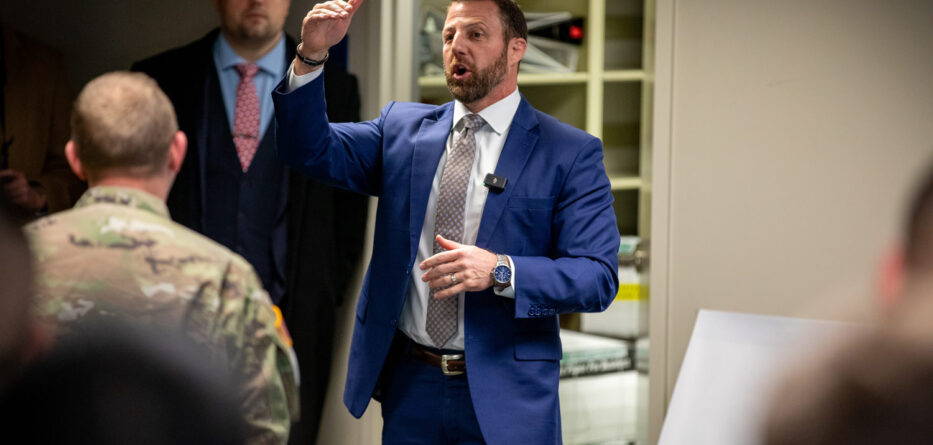
With 54 votes in favor and 45 against, the incoming Secretary of Homeland Security (DHS)—Republican Senator from Oklahoma Markwayne Mullin—was confirmed this week.
Prior to his political career, Mullin distinguished himself as a successful entrepreneur in the plumbing services sector and as a former mixed martial arts fighter with an undefeated record.
Of Cherokee descent, he is one of the few Native Americans in Congress—a fact that has shaped a significant part of his public identity.
With a direct and often confrontational style, Mullin has successfully positioned himself as an influential voice within the conservative wing of the Republican Party. He is a close ally of President Trump.
His challenge lies in managing a Department with over 250,000 employees—including ICE, CBP, USCIS, TSA, FEMA, the Coast Guard, and the Secret Service—amidst a budgetary battle and demands from Democrats to establish a new code of conduct regarding migration.
What can be expected from his arrival at the DHS, effective April 1st?
His leadership may signal a recalibration in the execution of migration policy: a phase characterized by more moderate rhetoric, yet remaining equally firm in its objectives.
Since his Senate confirmation hearing, Mullin has made it clear that the migration strategy is not being dismantled, but rather reorganized.
In a political climate where migration remains one of the most polarizing issues, the new DHS chief appears intent on lowering the political temperature without relinquishing control.
The first change lies in the operational sphere. The decision to require judicial warrants for ICE agents to enter homes or businesses—barring specific exceptions—introduces a significant nuance in terms of both legality and public perception.
This measure does not eliminate the authorities’ capacity for action; rather, it seeks to shield them against criticism regarding potential abuses or excesses. It is, in essence, a procedural correction that could reduce tensions with migrant communities and legal stakeholders, without slowing the pace of arrests.
A similar dynamic applies to the focus on prioritizing arrests within detention facilities over operations in public spaces. This measure does not imply a reduction in law enforcement, but rather a reconfiguration of where and how it is carried out.
Fewer images of high-profile raids, more strategic work within the judicial system. A less visible strategy, yet potentially just as effective.
However, Mullin has been emphatic that deportations remain on the table. The objective of increasing expulsions remains intact. In that sense, the substance of immigration policy remains aligned with a logic of strict enforcement.
But perhaps the most significant element is the tone. Mullin promises cooperation with Congress and a leadership style that is more technical than political.
In short, what appears to be on the horizon is a new way of executing immigration policy. Less open confrontation, more institutionalism. Less media noise, more procedure. For some, it will come as a relief, for others, merely a change in method.
This is no minor detail: the form may ultimately prove just as decisive as the substance.