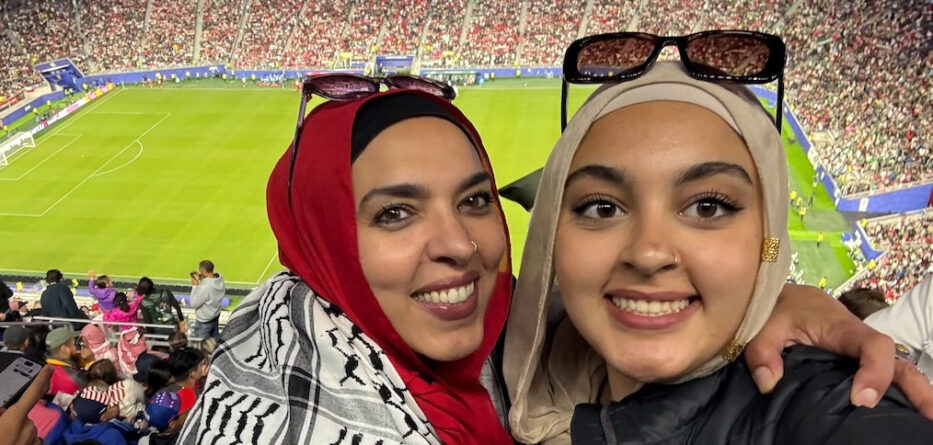
When Algeria and Jordan met June 22 on the World Cup stage in Santa Clara, the stands were blanketed with Palestinian flags and the iconic kuffiyeh scarf, now an international symbol of solidarity with the pro-Palestine cause.
For the Bay Area’s Arab community, the match brought a moment of shared joy in a year otherwise marked by grim headlines.
“Our communities locally and globally have gone through so much — being there, and feeling joy in itself, felt like an act of resistance,” said Manal Elkarra, a Palestinian born and raised in San Francisco who attended the match with her family.
“The atmosphere of camaraderie and unity and equity was a glimpse of what could be possible,” she said, adding the game was “pure joy.”
The match itself — which Algeria would go on to win 2-1 — was the first World Cup game ever played between two Arab nations other than Saudi Arabia. It drew fans from across the Arab diaspora, and not solely because tickets were slightly cheaper than other marquee matches.
Hayward resident Abraham Nevin treated his dad, who is from Afghanistan, after seeing how cheap the Algeria-Jordan match tickets were going for. He paid just $380 for 2 seats.
The US team’s July 1 match with Bosnia and Herzegovina at Levi’s Stadium, for example, saw mid-range tickets averaging between $3,000 and $7,000.
Nevin said their seats were “epic,” right next to the Algerian fan crowd. Besides Palestinian symbols, he says he even saw a guy in front of them wave the Lebanon flag every time Algeria scored.
Never before has the World Cup seen eight Arab nations competing in the tournament. This year FIFA, the World Cup’s governing body, expanded the team selection from 32 to 48, giving the games a broader global reach while also boosting revenues.
Jordan is a newcomer to the Cup, while Algeria is considered second only to Morocco, according to FIFA rankings of African teams.
The Palestinian national team did not qualify for the World Cup this year in large part due to the impact of the war on Gaza and Israel’s continued incursions into the West Bank.
Home matches could not be played, and a number of Palestinian players were killed in Israeli bombings, including Hani Al-Masdar, coach of the Palestine Olympic Football team, and players Ahmad Abu al-Atta, Anas Iqilan, and Muhammad Barakat.
As home to the largest Palestinian diaspora and with many of its citizens claiming Palestinian descent, Jordan’s national team carries special meaning for many Palestinians as well as for the kingdom itself.
“It was so cool to see so much Palestine there,” said Nevin. “Just united 100%… I’ve been rooting for both of them to be honest with you. I’ve really been so excited to just see all these Arabs just united in this way.”
Elkarra agreed, noting the chants for Palestine that filled the stadium. “Knowing Algeria’s role historically in the de-colonization and global liberation movement – it was not just a soccer game, being there felt like you were a part of this movement of ‘what if.’”
Algeria won its independence from France after a protracted war that ended in 1962. The conflict inspired similar independence movements across the globe, from South Africa to Vietnam and countries across Latin America.
Karim Abraham said that while exiting the stadium fans continued to chant in support of Palestinian freedom. “There were people wearing Palestine jerseys, or had Gaza mentioned on their clothing,” he said.
Algeria’s soccer team has become known for displaying symbols of Palestinian solidarity throughout its World Cup journey. The team hoisted the Palestinian flag on the field when it qualified for the tournament with a victory over Somalia last October.
Abraham lives in Oakland, and is of Lebanese-Iraqi background. He went with his brother and two family friends who happened to have spare tickets. They decided to root for Jordan because it’s geographically between Lebanon and Iraq. He says it was an energetic atmosphere, and at times even hard to tell the fanbases apart.
“Everyone was wearing a kuffiyeh, it wasn’t just the Jordanians,” he said. The scarf is also deeply enmeshed in Lebanese tradition. For Abraham, seeing the ubiquitous chequered fabric span both sides of the fan base highlighted its potency as a sign of “inter-Arab solidarity and camaraderie.”
After the match, the famous “One, two, three, viva l’Algerie!” shook the stadium. Abraham says, though, the pro-Palestine chants from those in red as well as green, were deafening.
Elkarra described flags from across the Arab world fluttering overhead, not only Jordanian and Algerian, but from Yemen, Egypt, Lebanon, Iraq, and Palestine.
As the tournament moves into the Round of 16 stage three Arab teams remain standing: Egypt, Algeria and Morocco. The latter, known as the Atlas Lions, are considered the strongest of the three. The team defeated the Netherlands June 29 during a dramatic end-game penalty-shootout.
During the 2022 World Cup, Morocco’s semifinal run electrified the Arab world, imbuing a sense of pan-regional unity, recalls Abraham. During the 2010 games he visited Lebanon with family and remembered how people vacillated between rooting for Germany or Argentina. That Morocco run in 2022 was the first time, he says, that he felt like Arabs were equal participants.
“It felt like this was a moment that we could all rally behind a team and that we had some form of representation,” Abraham said. “It makes it really feel like we’re just as much part of this as everyone else is.”
He added, “I’m hoping that it helps with the perception of Arabs and Arab countries in the US and the West. To see them be involved on the global stage in a way that’s not associated with war and violence.”
For Nevin, attending the game with his father carried special meaning. His father grew up in Germany after feeling the Soviet invasion of Afghanistan before coming to the US at 16. Nevin says his father talks often about the two options he had in life: join a gang, or play soccer.
His father often told Nevin how much the sport meant to him, and he always wanted to go to the World Cup.
“That was the first time in his life hugging me,” said Nevin about when he showed his dad the World Cup tickets. “I was like, I just bought the tickets. He was like, I love you so much.”
At the game, Nevin said when a team scored his father “would jump and scream and stuff. I’ve never seen him do that.”
He added, “I felt so proud, man. It was such a blessing. This is a legendary moment.”