Arturo Hilario
El Observador
Sometimes our journey’s in life may not be fully understood by those that are watching from afar and not in our shoes, whether it’s through the lens of education, politics or personal life choices.
What can break through the noise of misunderstandings and alienation is the shared humanity we all share, and the bits and pieces of us that are connected to the fabric of the human race.
Recently I spoke to Mexican actress Jaklyn Bejarano who stars in the new film Broken Land, a story that highlights the fractured but very real connections humans share, even if split by an invisible and political barrier, looking into each other’s souls and finding common ground can be true in even the most volatile situations. It also explores how we move within these conditions which can ultimately free us from our preconceptions of those we see as different to us and offer us a new perspective and even an opportunity to heal.
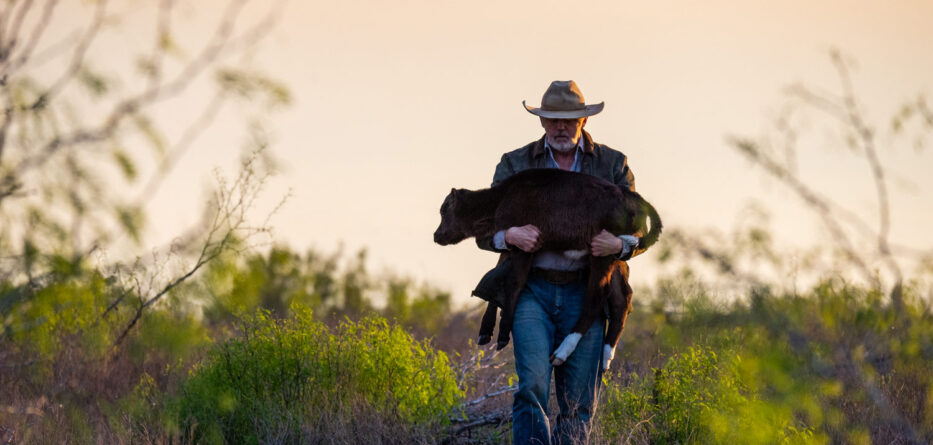
The film follows an isolated rancher named Carson (played by David Morse) who is haunted by the death of his wife years earlier. Living and working on the “Nueces Strip”, 60 miles from the U.S./Mexico border, there is at times only the sound of his thoughts, but sometimes migrants cross through the region, and with that border patrol and the anxious and at times chaotic moments when they interact.
When Carson accidentally shoots a young migrant woman named Irene, he must decide whether he will or won’t help her continue her perilous journey into the United States, risking discovery by his estranged son, who happens to be a U.S. Border Patrol agent.
According to the director of the film Joseph T. Walker, a Texas native whose family farm was a location used for the film, the goal of Broken Land is to show the human aspect of the border and immigration issue that rarely gets portrayed in sensationalized news stories and politicized conversations.
“The Nueces Strip is now a place where more border-crossing migrants die than anywhere else along the U.S.-Mexico frontier. What’s absent in this debate is the epic, emotional particularity of the individual people involved, on both sides of the border. Broken Land attempts to reclaim this humanity. It’s the story of two people, Carson and Irene, from either side of the border, who are forced by circumstance to confront each other — as individuals rather than abstractions.”
In the following interview, Bejarano speaks on her learning experience with her first lead role in a production, the heavy energy felt in filming in a place where border crossings and deadly situations arise, and how her own experiences with migration in her family connect her to her character and the situation in a deep and personal manner.
Broken Land is now available on digital formats.
It really resonated with me because my dad, too, when I was very young, about 5 years old, came to the U.S. hoping to find a better life, better opportunities, and above all, financial stability for his family so he could send us money to Mexico.
-Jaklyn Bejarano
Hi Jaklyn, thank you so much for this opportunity. To start off, what does it mean to you that Broken Land is your first leading role?
Well, I think it represents the result of years of work, in other words, reaping what you’ve sown. I think it’s coming at just the right time because opportunities often arise, and I believe that if this had come my way five or eight years ago, I wouldn’t have been ready for it, maybe I wouldn’t have approached it the same way, or I wouldn’t have understood its full scope or how to translate it into my body.
So, I think it’s been years in the making and that it’s coming at just the right time, not only on a personal and professional level, but also on a regional and social level.
What aspects of the story and the script drew you to this project?
Well, ever since my agent Stephanie Ripstein, who has been with me throughout this whole process, sent me the casting call, I read two of Irene’s scenes and they really resonated with me because my dad, too, when I was very young, around 5 years old, came to the U.S. hoping to find a better life, better opportunities, and above all, financial stability for his family so he could send us money to Mexico.
I don’t remember the exact details, but I do remember that as a little girl I didn’t understand a lot of things, I didn’t understand why he had to leave, why he had to abandon us. And now I can really grasp the magnitude of it. So when I read about Irene, a lot of things really hit home. Obviously, Irene is a character on the edge. She’s not even looking for a better work-life balance, she’s fleeing her country just to survive. So I think it resonates with me in many ways, both personally and professionally. These are stories that need to be told and shared.
What aspects of your character, Irene, resonate with you, or do you see any traits or similarities between her and your own experiences?
Yes, I think Irene is a woman who is just trying to get by, but she’s also a very brave woman. Even though she’s often not very rational, she’s more instinctive, she’s an incredibly brave and loving woman, and in the end, love is what drives her, isn’t it? That survival stems from love. So with Irene, I understood that; I understood that there are things far more important than what we prioritize in the day-to-day fabric of life.
What was it like working with the cast and crew in Texas, and filming there in a region where these clashes do occur between people seeking a better life and other forces that don’t believe they should be there or should be allowed to pass through?
Well, it was unique, wasn’t it? It was a small film crew. So we all knew each other really well, we spent a lot of time together, and I think that created a real sense of family among us and a lot of support. I had never worked on a film like that before, but I was impressed by the level and professional quality of each member of the team, and how generous they were to me, supporting me, hugging me, making me feel like part of the group, making me feel safe. And above all, well, also because there’s a lot of racism, and there’s quite a bit of racism around where we were filming.
So they tried to keep an eye on me in that regard. I never had any incidents. But actually, out in the countryside, now that you mention it, there was one day when we had to cancel the afternoon shoot because someone had broken into the ranch. We didn’t know if they were immigrants or something else. So, for safety reasons, we had to suspend filming. And really, well, yes, those were unique circumstances because there was nothing nearby; we were filming in a small town where there are very few places to go. But I felt great, you know? Even though the conditions weren’t the best, I felt good because I was happy with the project, and I was happy with my team.
And the truth is, I couldn’t have asked for anything better. That’s just how it was, those are the conditions, those are the areas where migrants pass through all the time. So it couldn’t have been anywhere else; it couldn’t have been on a film set. It had to be there so we could experience it, feel it, and it’s a place with a very intense energy.
And why do you think it’s important to tell a story like this about individuals and the significance of their lives, their shared humanity?
Because I think that, in general, we’re a little disconnected from other people’s experiences, and a lot of the time we don’t even care, because there are so many problems in our daily lives, because everyone has their own firmly held beliefs, and we rarely stop to look at another person and the struggles they might be facing. And immigration is a huge issue that we’ve already normalized, you know? I feel like suddenly it’s like, “Oh, immigrants again? No, not anymore.” And in the end, they also become statistics and just numbers. It’s about recognizing and giving a voice to those stories, stories like Irene’s, that are worth telling so we can pause for a moment and reflect. I think it’s not about pointing fingers and saying whether it’s good or bad, but understanding that it’s a complex situation.
What can you tell us about what you’ve gained from your experience working on Broken Land?
It has taught me so much, both technically and as an actor. It has allowed me to grasp what it means to delve deeper and deeper into a character. It has also allowed me to understand the professional world of film and fall even more in love with cinema because I had never made a film before, so I didn’t know how it worked, I had certain reservations, but it’s wonderful, and you can tell a story in a very poetic way, or not. And it leaves me wanting to make more films, but with narratives this powerful.
And one final question. For the audience watching this film, what do you hope they’ll take away from Broken Land?
I hope they can take a moment to reflect and put themselves in Irene’s shoes—but also in Carson’s, because Carson is at a crossroads. He’s torn between what he should do and what he shouldn’t, between what he wants to do and what he doesn’t.
And in the end, I think it’s very easy to judge certain decisions, or to judge certain actions, the actions taken by others. But when we really take stock of the situation or the circumstances, I think it goes far beyond simply pointing it out. And I’d like the audience to give themselves the chance to take stock of that, to really experience it, and to understand it from a different perspective.